
Resideo makes home-control and safety equipment. For the quarter ended October 3, it reported $727 million in revenue and $31 million in continuing-operations net income; gross debt was $2.1 billion. Its November 10 results also disclosed a $1.1 billion debt repayment following the ADI separation. Company filing
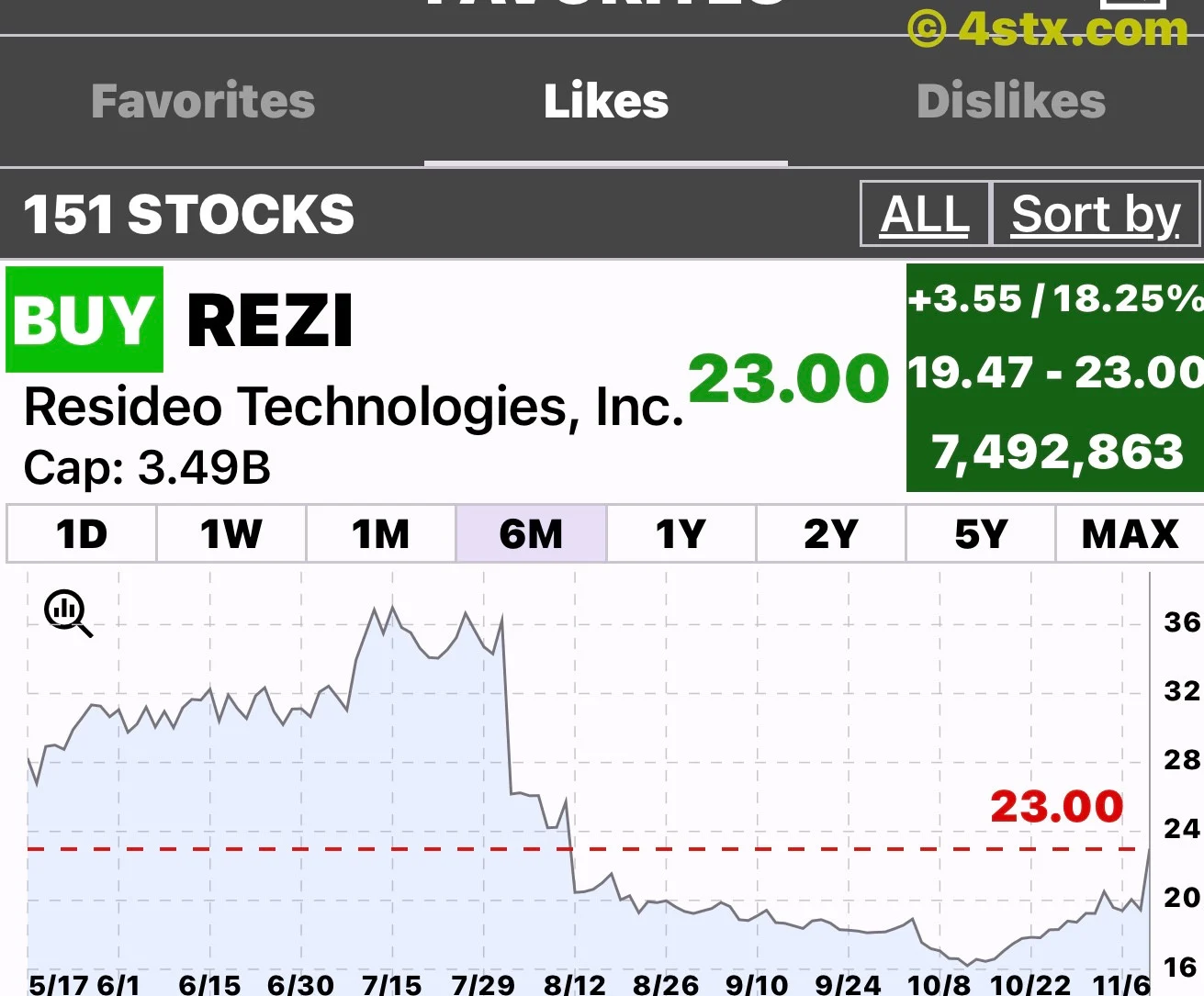
Eric’s StockRank screenshot shows REZI at $23.00, up +18.25%. The interesting question is whether investors are rewarding a simpler business rather than spectacular growth. Paying down debt is good; assuming the remaining obligations no longer matter is not. This looks like a reassessment of the post-separation company, not evidence that housing-related risks have disappeared.
What the six-month chart shows
The six-month chart adds an important complication. The displayed share price rose into July, dropped sharply around August and weakened into October; the latest month instead shows a rebound. But ADI was separated on August 3. A stock-only chart spanning that distribution is not a reliable measure of shareholders’ total return. The recent recovery is visible; a claim that investors lost the entire displayed summer-to-autumn decline would be misleading.
Why a smaller company can attract a bigger valuation
The separation changes the investment question. A conglomerate can be difficult to judge when one activity obscures another. After a distribution, investors must reconsider what the remaining company earns, what obligations it retains and which comparisons still make sense. Resideo's fresh results give them a starting point. They do not, on their own, establish that every buyer was reacting to the same information. The earnings release is the documented backdrop; the explanation of the rally is an interpretation of that backdrop.
The debt repayment matters because borrowing is a claim on future business cash. Reducing it can leave a company better positioned to withstand a disappointing period or fund useful investment. That is a real improvement in financial flexibility, not merely a cosmetic change to the company name. But gross debt remains substantial. It would be a mistake to read the repayment as permission to stop examining financing costs, maturities and cash generation. A smaller debt pile can still constrain a business.
What shareholders should compare next
Continuing-operations earnings deserve particular attention after a separation. They describe the activities remaining in the reporting group rather than blending them indiscriminately with a business that has left. A useful next step is to compare equivalent businesses over equivalent periods. Simply putting an old consolidated earnings number beside a new standalone number can create a false impression of growth or deterioration. The same discipline applies to the chart: a distributed asset must not disappear from the shareholder-return calculation.
For the operating story to strengthen, future results need to show that the remaining business can repeatedly turn its sales into earnings and cash. Revenue gives scale; profit gives only part of the quality test. Cash generation helps reveal whether reported earnings support obligations and investment rather than staying tied up in working capital. These are questions for subsequent filings, not claims that an improvement has already occurred.
The most persuasive bullish case is therefore a cleaner company with a more manageable financial burden. The counterargument is that simplification does not automatically improve demand or eliminate execution risk. At the screenshot price, investors appear more willing to entertain the first case. The next business results, not the size of this jump, will decide how durable that optimism deserves to be.
The quoted gain is the app's November 11 snapshot, not a measured six-month return or a verified official closing change. No exact monthly return is inferred from the image.
The company’s closing filing confirms that ADI became an independent listed business following the distribution. That is why the separation changes the meaning of a historical REZI-only chart. ADI separation closing filing