
OneWater Marine sells boats and related services, parts, financing and insurance products. Its fiscal 2026 revenue was about $1.8 billion, placing it well beyond the scale of a speculative startup. Nevertheless, its customers make discretionary purchases, and a difficult boating market can pressure even a substantial retailer. The company reported an $8.4 million annual net loss. Fiscal results
An earnings catalyst, not a mystery
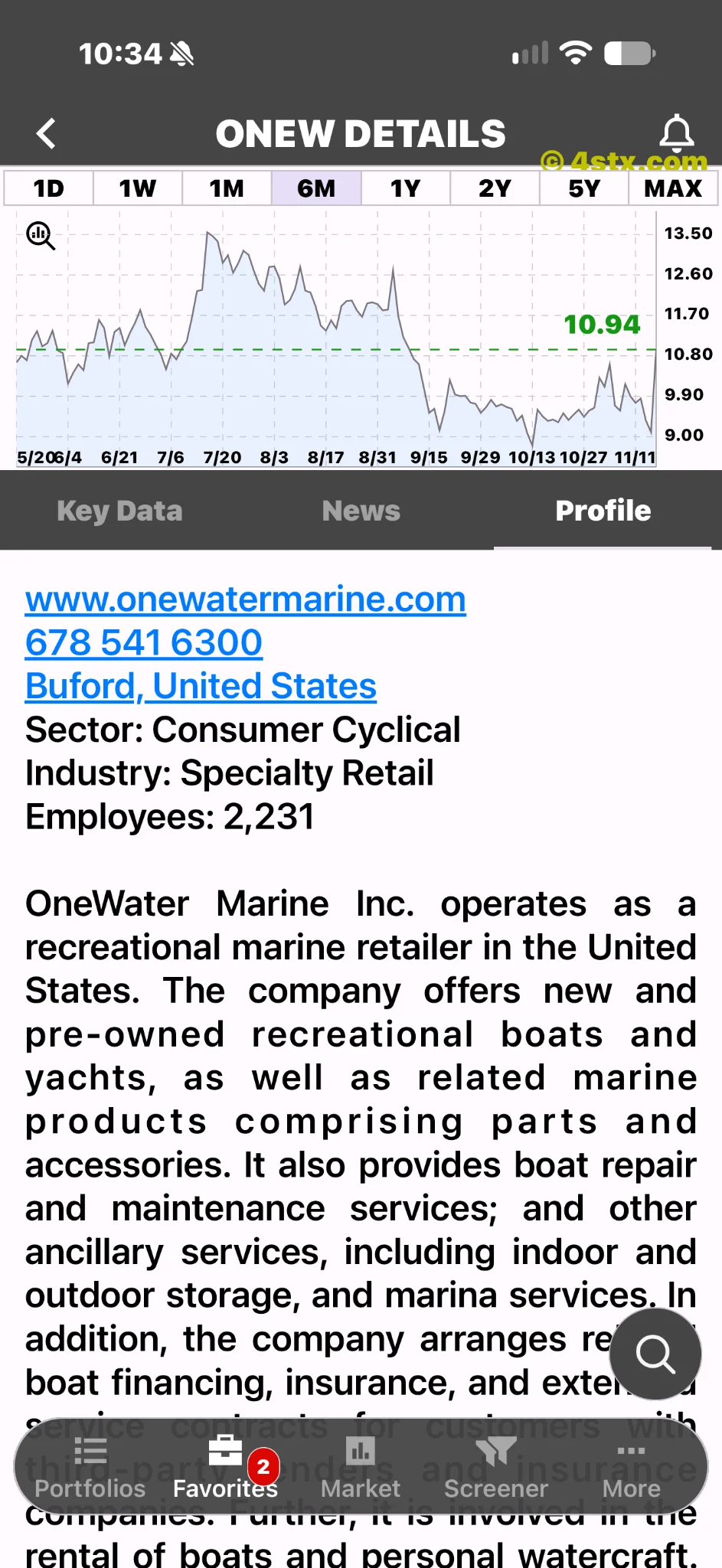
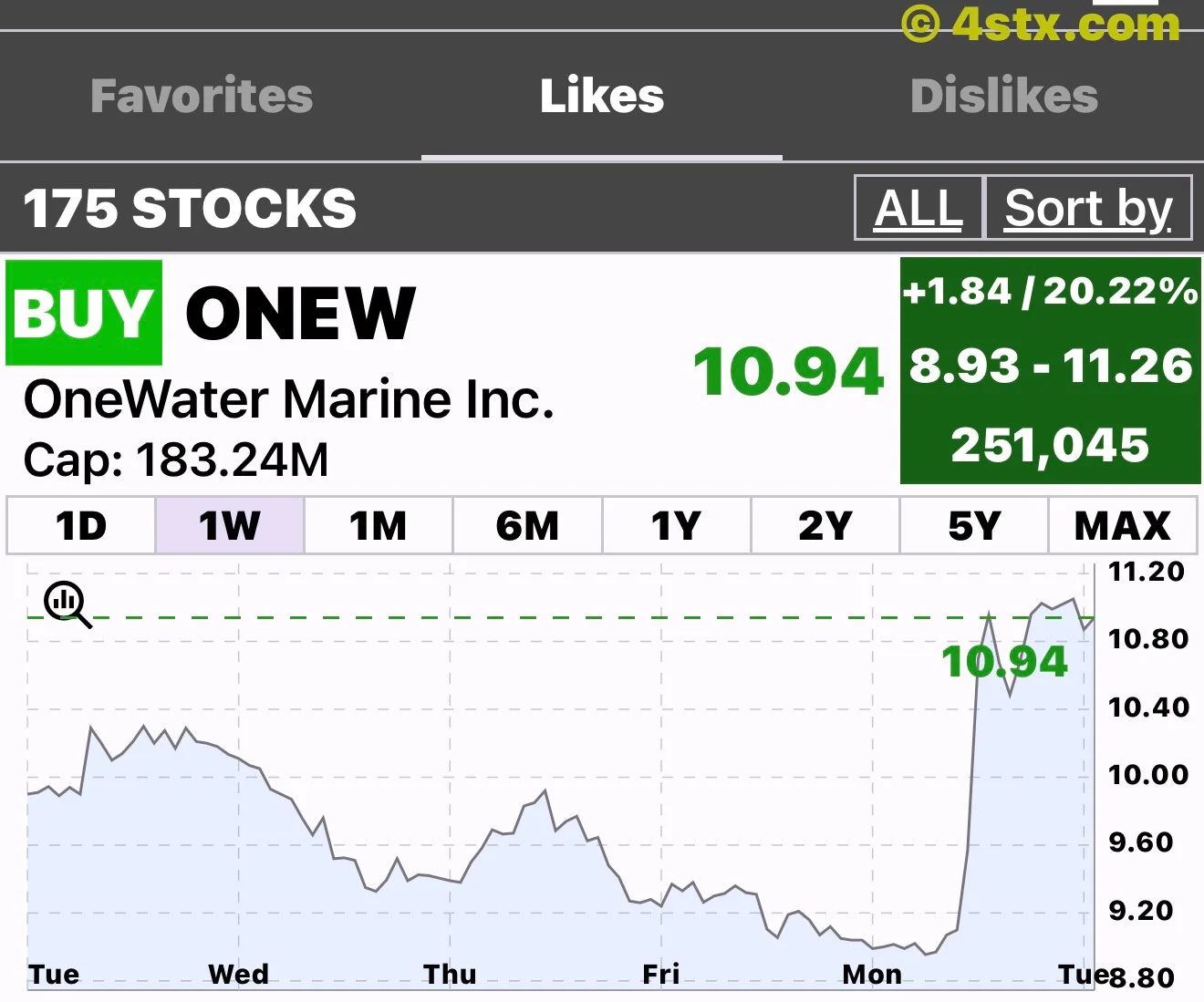
The StockRank screenshot supplied on November 17 shows ONEW at $10.94, up +20.22%, with 251,045 shares traded. These are intraday figures rather than an official closing quote. OneWater released quarterly and annual results that morning, providing a clear event to examine instead of inventing a takeover rumor or assuming a short squeeze.
The fourth quarter’s adjusted earnings of $0.13 per share exceeded the $0.05 analyst estimate reported by Investing.com. Revenue of $426.03 million was below its quoted consensus. The same report put the company’s fiscal 2027 adjusted earnings outlook of $0.75–$1.00 above the $0.42 consensus. Earnings comparison
That combination is consistent with a market rewarding future profitability rather than current sales growth. It is an interpretation of the timing and results, not proof that every trade was motivated by the same factor.
Selling less can still produce better economics
The company reported annual gross margin of 23.7%, an improvement of 90 basis points. A better margin means more gross profit retained from each dollar sold, before operating expenses and other costs. That is useful when demand is not offering an easy route to growth.
Our reading is that the encouraging part is discipline, not a sudden boom in boat buying. A retailer can improve its position by managing stock carefully and avoiding sales that generate too little return. The less encouraging part is that management still needs customers willing and able to spend. Better execution cannot remove the economic sensitivity of the product.
The balance sheet deserves attention
OneWater reported $342.3 million in long-term debt at September 30, down −$69.8 million year over year, and $53.7 million in cash. Its adjusted net-debt leverage measure fell to 3.8 times from 5.1 times. These figures are company-defined or reported measures and should not be confused with an absence of financing risk. Company financial release
Reducing leverage matters because interest and repayment obligations compete with reinvestment. It also creates room for disappointment if the recovery is slower than hoped. Investors should examine financing arrangements alongside the income statement rather than treating a lower debt number as the end of the analysis.
Valuation after the jump
At the screenshot price, dividing $10.94 by the company’s $0.75–$1.00 adjusted earnings outlook produces a rough forward multiple of 10.94–14.59. This is a calculation using management’s non-GAAP forecast, not a trailing GAAP P/E or a promise that those earnings will arrive.
The supplied one-week chart shows a jump from below $9.20 toward $11, interrupting a recent decline. The six-month view shows that $10.94 remains below the summer peak near $13.50. The rebound is therefore not the same as a return to the period's high. No average-volume series is supplied, so an unusual-volume multiple cannot be calculated. Its BUY label belongs to StockRank, not this article. For now, the strongest explanation is an earnings-and-outlook reassessment. The next proof must come from sustained margins, cash generation and actual demand, not another green percentage.