
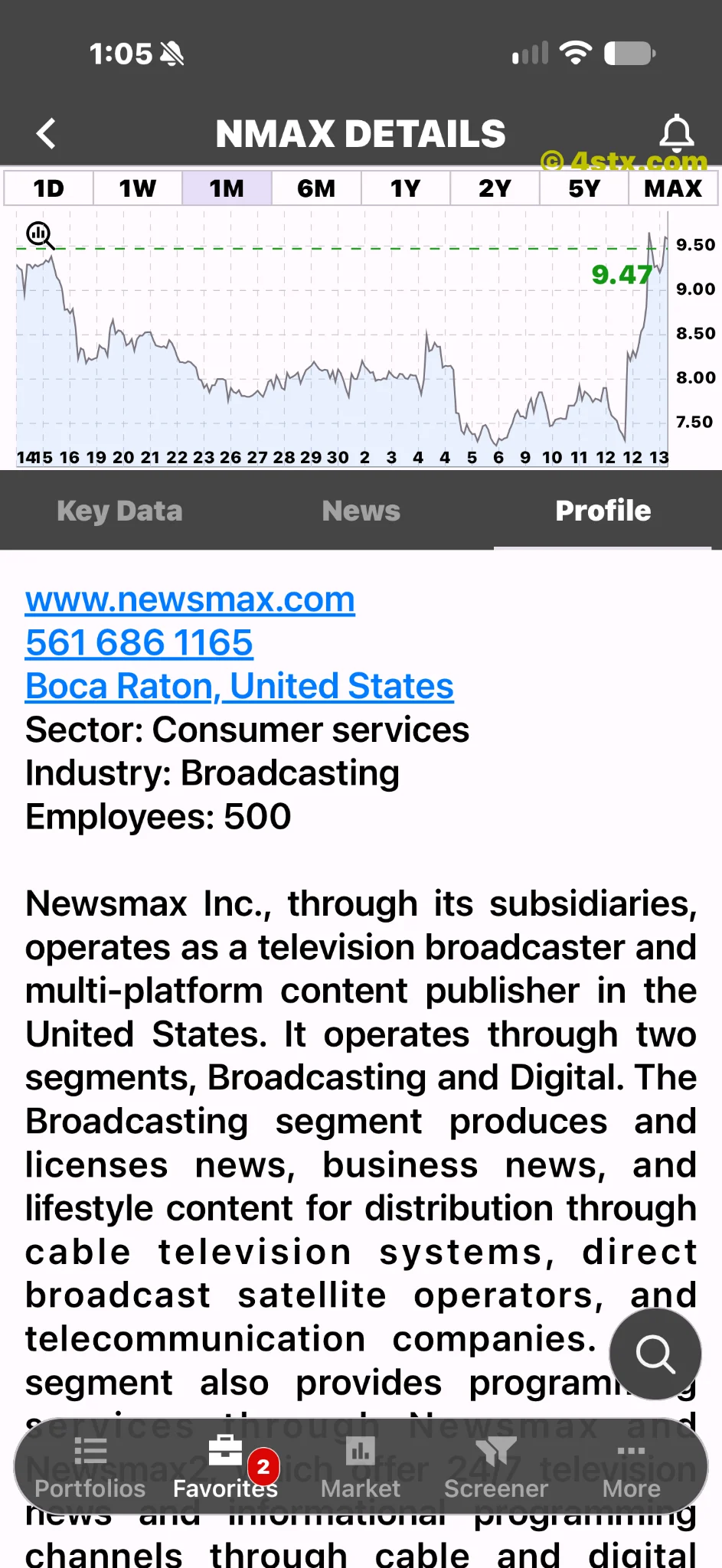
Newsmax runs a television and digital-news business, and its September-quarter report gave investors a striking headline: $69 million in revenue and $15.2 million in net income. Management said it had no debt, although the balance sheet separately includes lease and settlement obligations. Cash and investments totaled $137.6 million at September 30. The essential complication is a $14 million one-time termination payment included in revenue. A good quarter is more convincing when readers can separate the repeatable business from the exceptional boost. StockRank’s profile lists 500 employees, an app-displayed count rather than an independently verified current headcount. Quarterly filing and management commentary
Growth beneath the exceptional payment
Excluding the payment, revenue was $55 million, up +21.6%. Affiliate fees and licensing helped the business, while adjusted EBITDA excluding the item was $5 million rather than the headline $19 million. These results were released after the November 12 close, one day before the rally snapshot. Quarterly report
The appeal is understandable: a news outlet can become more valuable when distribution contracts generate better economics without requiring an equivalent increase in costs. Newsmax’s investor presentation identifies affiliate-contract renewals as a growth opportunity, but that remains management’s case, not a promise that every renewal will achieve its desired terms. Investor presentation
The constructive development is that underlying revenue still grew after removing the special payment. The caution is equally important: applying the entire reported quarterly profit to every future quarter would build an investment thesis on money that may not return.
Investors noticed, and turnover accelerated
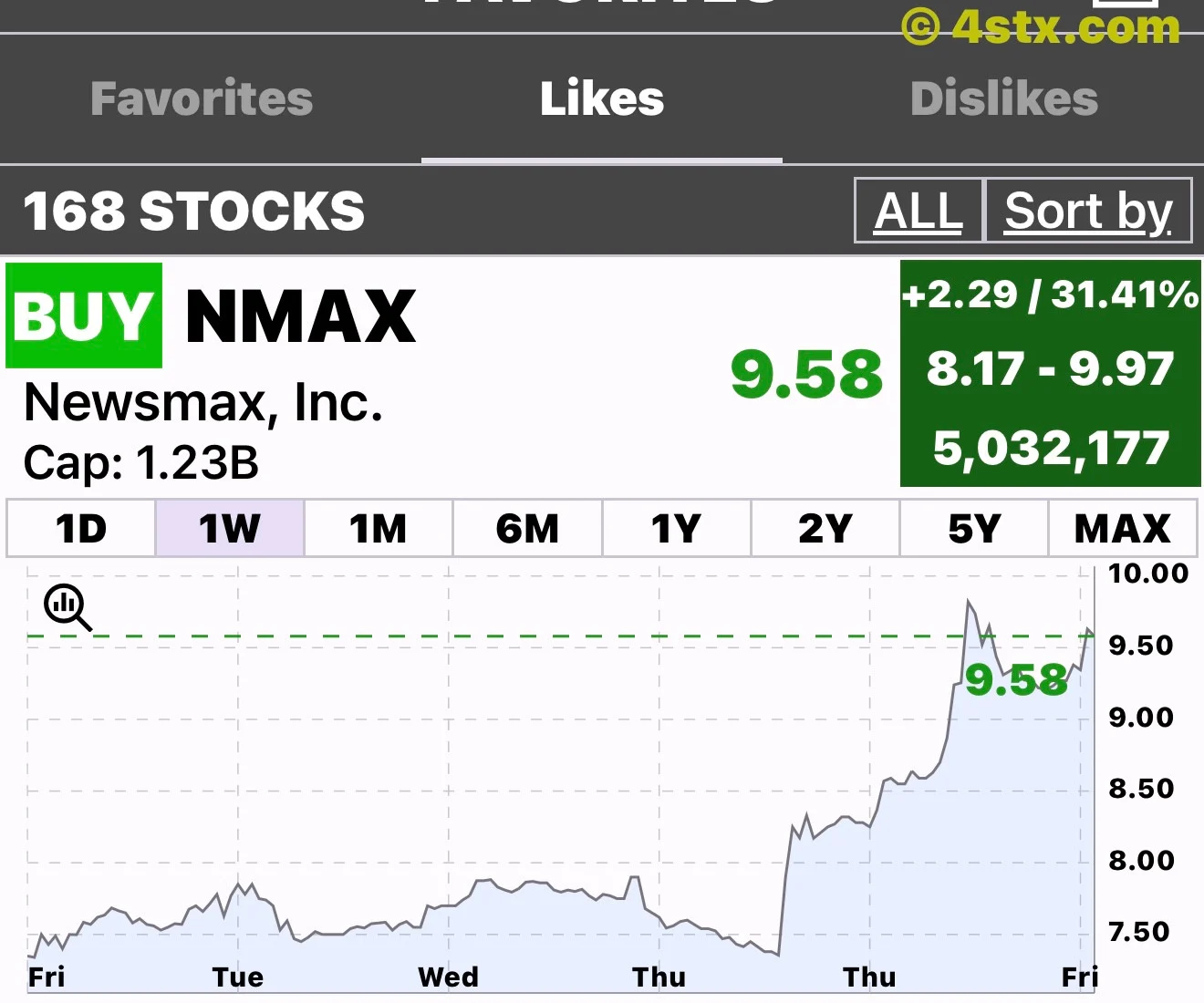
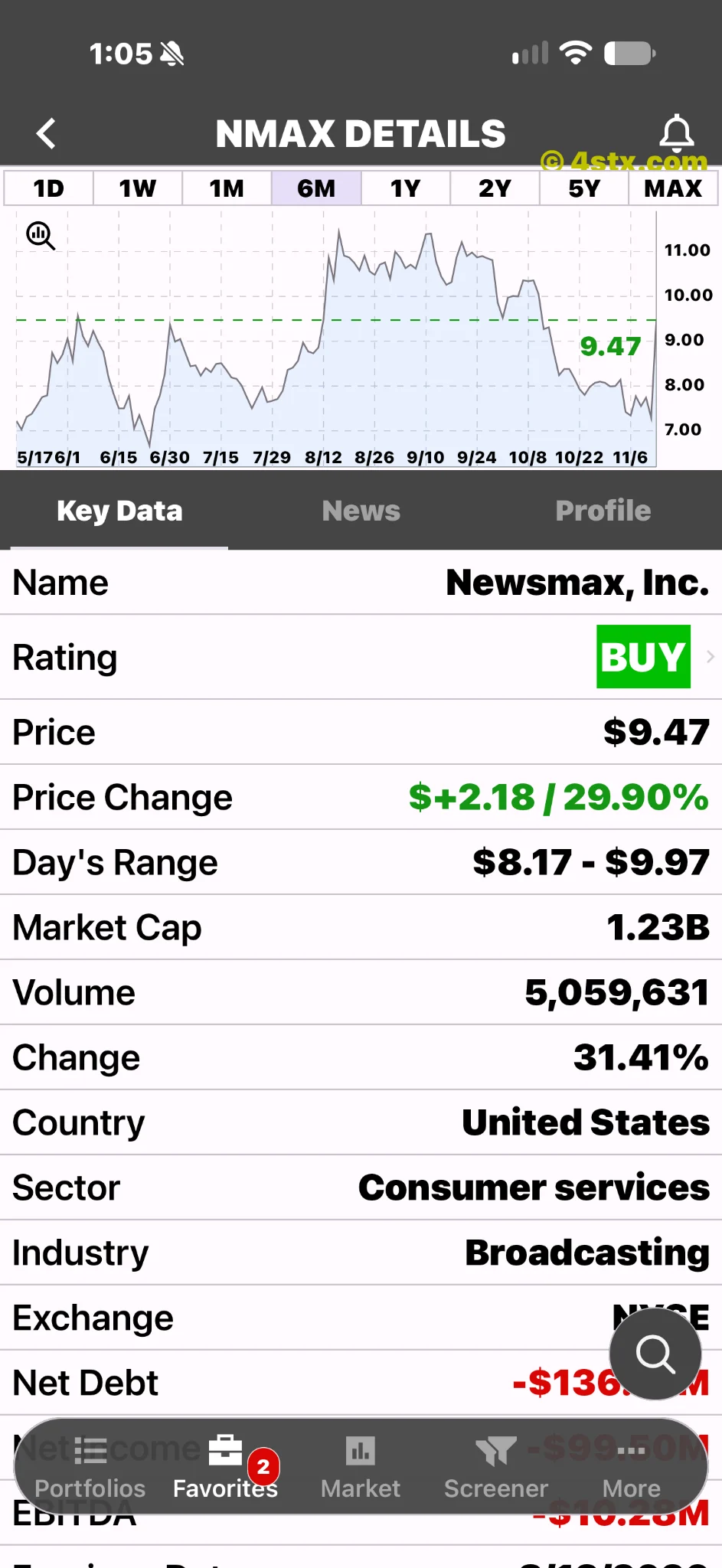
The newer November 13 StockRank weekly screenshot showed NMAX at $9.58, up +31.41%, with 5,032,177 shares traded. The separate details image showed $9.47, +29.90% in its Price Change row, and volume of 5,059,631; its separate Change row still read 31.41%. These are distinct app snapshots and fields, not one synchronized closing quote. Against the previously checked 20-day average of 888,408 shares, the details image’s volume was about 5.70 times that full-day baseline. The comparison measures elevated turnover, not a precise same-time relative-volume reading. Trading statistics
That supports a statement about intense market attention, not a claim that millions of fresh long-term investors arrived. Buyers and sellers meet in every transaction. A stock can attract extraordinary turnover while opinions about its underlying value remain sharply divided.
The rebound is fighting a recent downtrend
The six-month chart rose from roughly $7 in May to above $11 in August and September, then declined toward $7–$8 before the latest jump. Its overall endpoint is higher, but the path is not a steady uptrend. The one-month chart makes the contrast clearer: a slide from around $9.30 toward $7.30 was abruptly interrupted by a rebound to $9.47. This is a sharp recovery from recent weakness, not yet a return to the summer peaks. The weekly image reinforces how concentrated the latest acceleration was near the right edge of the chart.
A better business is not automatically a cheap stock
Stock Analysis’s separate November 13 valuation snapshot showed trailing P/E of 95.46 and trailing P/S of 5.26. The earnings multiple sits above our rough 40-times expensive threshold. It compares price with historical earnings, not guaranteed future profit. The sales multiple sits below 10, but that does not negate the demanding earnings valuation. Valuation snapshot
These provider ratios are not recalculated at the screenshot’s exact price. Their usefulness is directional: investors are paying for improvement, and the price already embeds meaningful expectations. A low-looking sales multiple cannot tell us how much revenue will remain after programming, distribution, staffing and other costs.
For readers weighing the news, the distinction between growth and valuation matters. An earnings surprise can explain why a share attracts attention without demonstrating that the new price is attractive. A disciplined reading asks what the business earned, how much was repeatable, and what expectations the price now assumes. None of those questions is answered simply by the size of Friday’s percentage gain.
The latest earnings announcement was yesterday, November 12. No subsequent company-confirmed date was verified; third-party calendars disagree. The next useful checkpoint is therefore the company’s own announcement, not an invented countdown. Newsmax has supplied evidence of progress. Its next challenge is to show how much survives without the unusual payment.