
Merlin develops autonomous-flight technology for military and civilian aircraft. It remains a small revenue business: in the quarter ended September 30, 2026, it generated $3.46 million of sales and reported $73.84 million of GAAP net income. That unusually large profit was not evidence of an aviation cash machine. It included a $103.62 million gain from revaluing warrant liabilities, while operations lost −$31.47 million. Merlin reported no debt and $161.6 million in cash, cash equivalents and short-term investments at quarter-end. Those distinctions are central to understanding the story, not accounting trivia. (Quarterly filing)
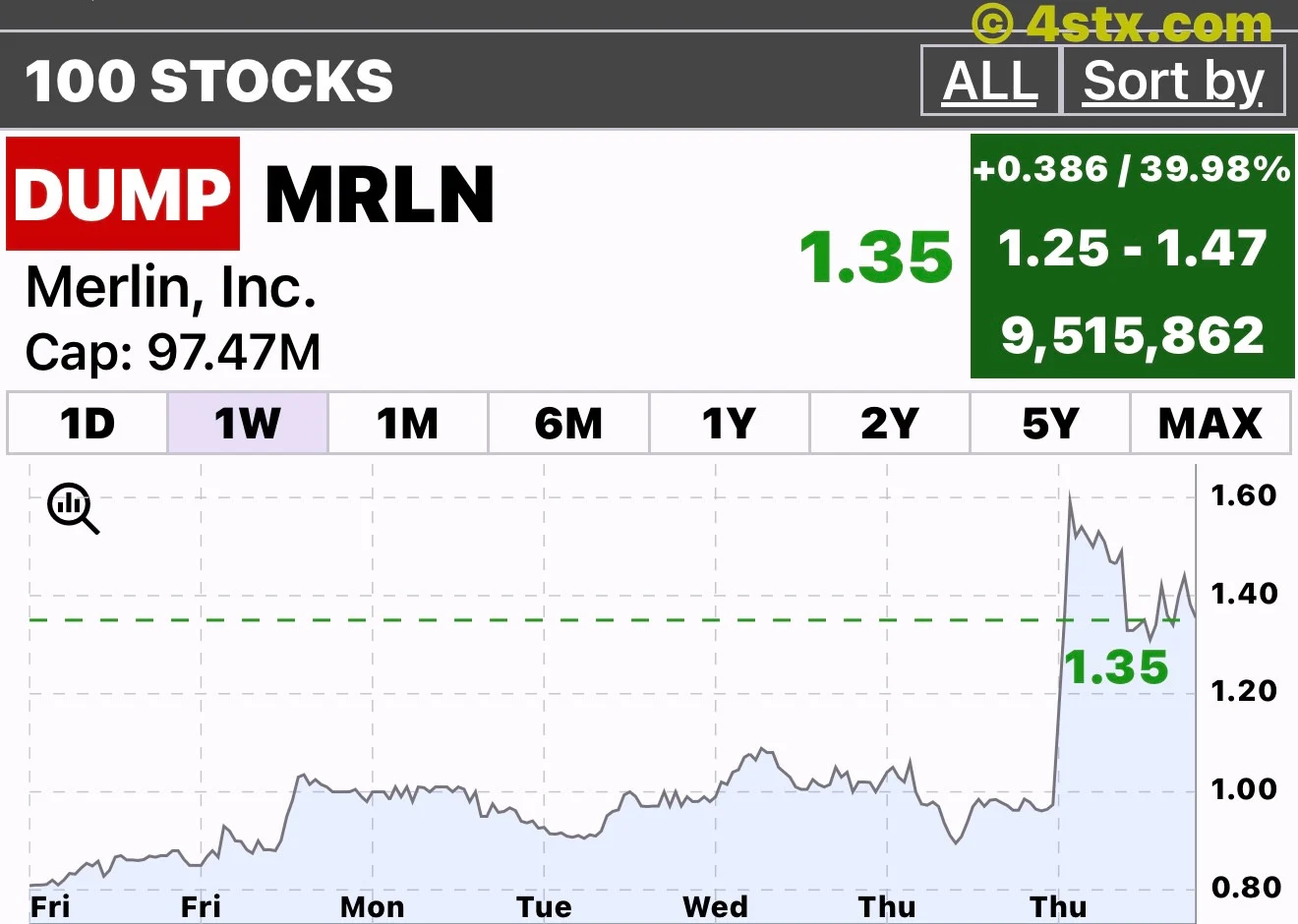
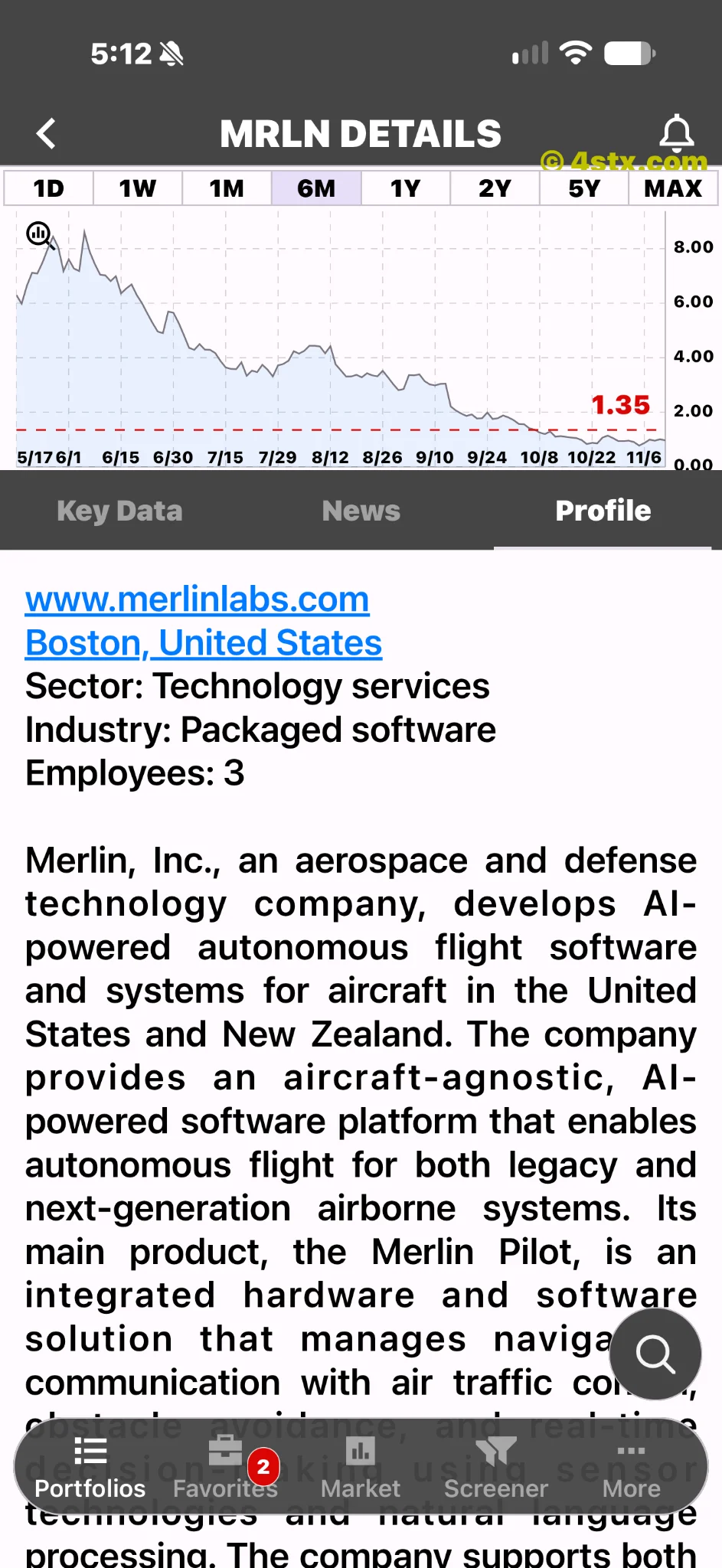
The November 13 premarket StockRank screenshot showed MRLN at $1.35, up +39.98%. It is a captured app quote, not a closing price or a promise that the gain will survive the opening bell. The rise came after an unusually busy week of company announcements: two defense-program developments followed by results released after the November 12 close. That sequence provides a credible news backdrop, although it cannot identify the motivation behind every trade.
Customers are paying for the next step
The most encouraging development is not the headline profit. It is a customer committing money to further engineering. On November 10, Merlin announced an $8.9 million USSOCOM task order to move its C-130J autonomy program into integration and preparation for future flight demonstrations. The award follows design reviews and covers further validation work. It is not an announcement that production aircraft are already being delivered in volume. (Task-order announcement)
This distinction matters. A development-stage company can attract attention with a large addressable market, but a funded assignment provides something more concrete: a customer, a defined next phase and money attached to it. That is good progress. It still leaves difficult questions about execution, scheduling and the economics of scaling the technology. A contract ceiling should never be confused with cash already collected or revenue already earned.
On November 11, Merlin also announced a $500,000 AFRICOM contract for an autonomous casualty-evacuation demonstration using a Cessna Grand Caravan. This is a separate initial-phase award, not a guarantee of a much larger follow-on program. Its appeal is understandable: it offers another setting in which the same flight technology could demonstrate practical usefulness. Its commercial value will depend on what happens after the demonstration, not simply on the ambition of the mission. (AFRICOM announcement)
A profit that did not refill the bank
Warrant accounting can produce a counterintuitive result: a decrease in the measured value of a liability can lift reported earnings without creating new customer receipts. That is why treating Merlin’s GAAP profit as recurring operating success would be misleading. Investors should read the income statement alongside operating performance and liquidity, rather than choosing the most flattering number.
Management reported an adjusted EBITDA loss of −$24.1 million, an improvement from the preceding quarter’s $27.8 million loss, and outlined a goal of lowering 2027 operating expenses. Its aim to fund the plan into 2029 without further capital raises is a management objective, not a financing guarantee. (November 12 results and outlook)
The sensible optimistic case is therefore narrower than “Merlin has become profitable.” It is that funded work and spending discipline might give the company more time to turn engineering into a larger business. The skeptical case is that revenue remains modest relative to the operating burden. Both can be true at once.
What the screenshot cannot establish
The six-month chart shows a clear downtrend, from peaks above $8 in late May and early June toward roughly $1 in the autumn. The latest month was mostly weak and near the lows rather than a sustained recovery. The separate one-week chart shows the sudden jump from around $1 toward $1.60 and then a retreat toward the $1.35 snapshot. That sharp rebound changes the short-term picture, but it has not erased the longer decline or established a durable reversal.
For now, the compelling story is the gap between technical progress and financial maturity. The fresh awards give investors something tangible to examine. The operating loss reminds them how much remains unfinished. A dramatic premarket jump can draw attention to that debate; it cannot settle it.