
JX Luxventure is a China-based wholesale and cross-border consumer-goods business pursuing a larger position in pharmaceutical distribution. The latest annual financial statements verified for this report show 2025 revenue of $82.94 million and a net loss of −$11.00 million. Its December 31 balance sheet separately reported $1.573 million of short-term loans and $2.120 million of notes payable, plus related-party balances and a small lease liability. These are dated annual figures, not current-quarter results; a more recent quarterly statement was not verified.
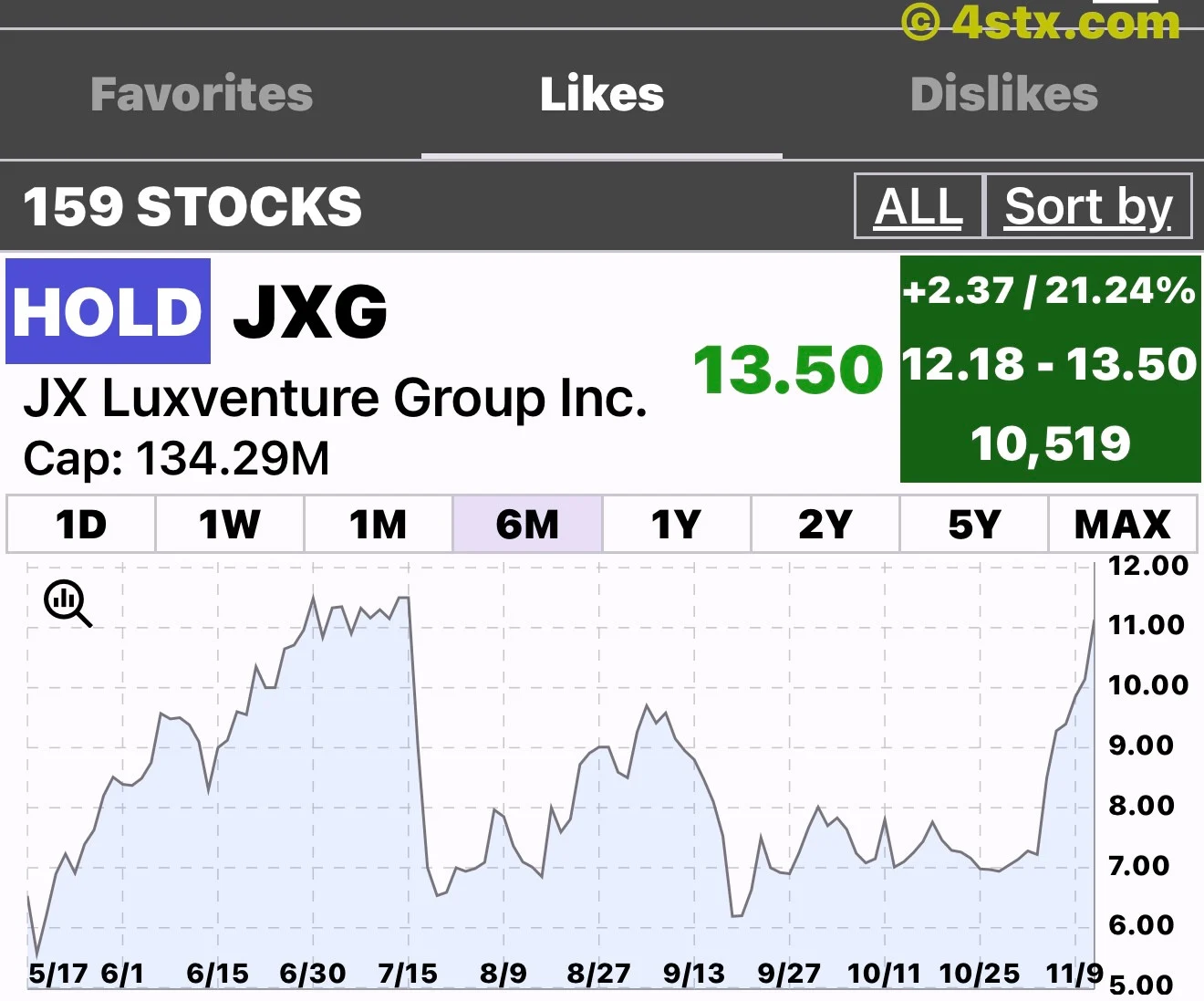
The November 12 StockRank screenshot shows JXG at $13.50, up +21.24%. The conspicuous recent development is a November 9 agreement to increase its interest in Dazzly Investment, a pharmaceutical-distribution business. That is a tangible corporate event to investigate, rather than an invented explanation based solely on a green price. It remains context for the rise, not proof of every investor’s motive.
Buying more without paying cash
Under the newly disclosed arrangement, JX Luxventure would acquire another 19% of Dazzly by issuing 4.97 million common shares. Combined with its existing stake, ownership would reach 29% upon completion. The agreed share valuation is $7.52. Dazzly operates through Hong Kong subsidiary Lang Hui Trade, connecting drug manufacturers with downstream customers.
There is a coherent strategic idea here. A wholesale operator may see pharmaceutical distribution as another way to deploy purchasing relationships, logistics and customer access. However, strategic similarity does not establish that the investment will generate attractive returns. Medicines have their own regulatory, inventory and commercial requirements, and investors need evidence about the target rather than simply an appealing sector label.
The most important word is “would.” The filing describes an agreement with closing conditions, including a Nasdaq additional-share notification process. Signing a transaction does not establish that the shares have been issued or that the larger ownership position is already effective. This report does not treat the proposed purchase as completed.
The cost appears in the share count
Paying with shares avoids an immediate cash acquisition payment, but it does not make the purchase free. Existing owners exchange part of their relative interest in JX Luxventure for exposure to an additional asset. Whether that is worthwhile depends on the value received compared with the ownership surrendered.
That is why a rally and dilution can coexist. Traders may like the strategic direction while longer-term investors still need to examine the economics. The relevant question is not simply whether the company owns more tomorrow. It is whether each existing share has a stronger claim on future earnings or cash generation after the transaction.
The historical accounts make that distinction especially useful. Rising sales and a net loss can exist together. Revenue measures activity; profit measures what remains after costs. Acquiring another investment cannot, on its own, establish that the underlying business has solved its profitability problem. The next meaningful evidence would be updated operating results and clearer information about the acquired interest’s contribution.
A promising headline is not a finished investment case
Investors should watch for closing confirmation, the final share count, subsequent financial disclosures and evidence of returns from Dazzly. Those milestones are more informative than treating the screenshot’s percentage change as an endorsement of the deal’s value. A minority stake also should not be casually described as ownership of the entire pharmaceutical business.
The six-month chart is uneven rather than a smooth climb: an early-summer advance was followed by sharp setbacks in July and September, then a flatter October period. The latest month looks stronger, with a visible late-October and November acceleration. That is a constructive change in direction, but not proof that every earlier setback has been overcome. The $13.50 header sits above the historical line’s endpoint; exact returns require synchronized, corporate-action-adjusted data.
The interesting story is expansion with a visible price attached. It is constructive that shareholders can inspect an actual agreement rather than a vague ambition. The concern is equally concrete: new shares and an unproven earnings contribution. JXG’s rally makes the transaction worth reading closely; it does not eliminate the need to do so.