
Fossil sells watches and accessories. Its quarter ended October 3 produced $271.2 million in sales and $11.7 million in net income, versus a year-earlier loss. Debt was $208 million. On November 10, the company raised its annual outlook after stronger margins. Company results
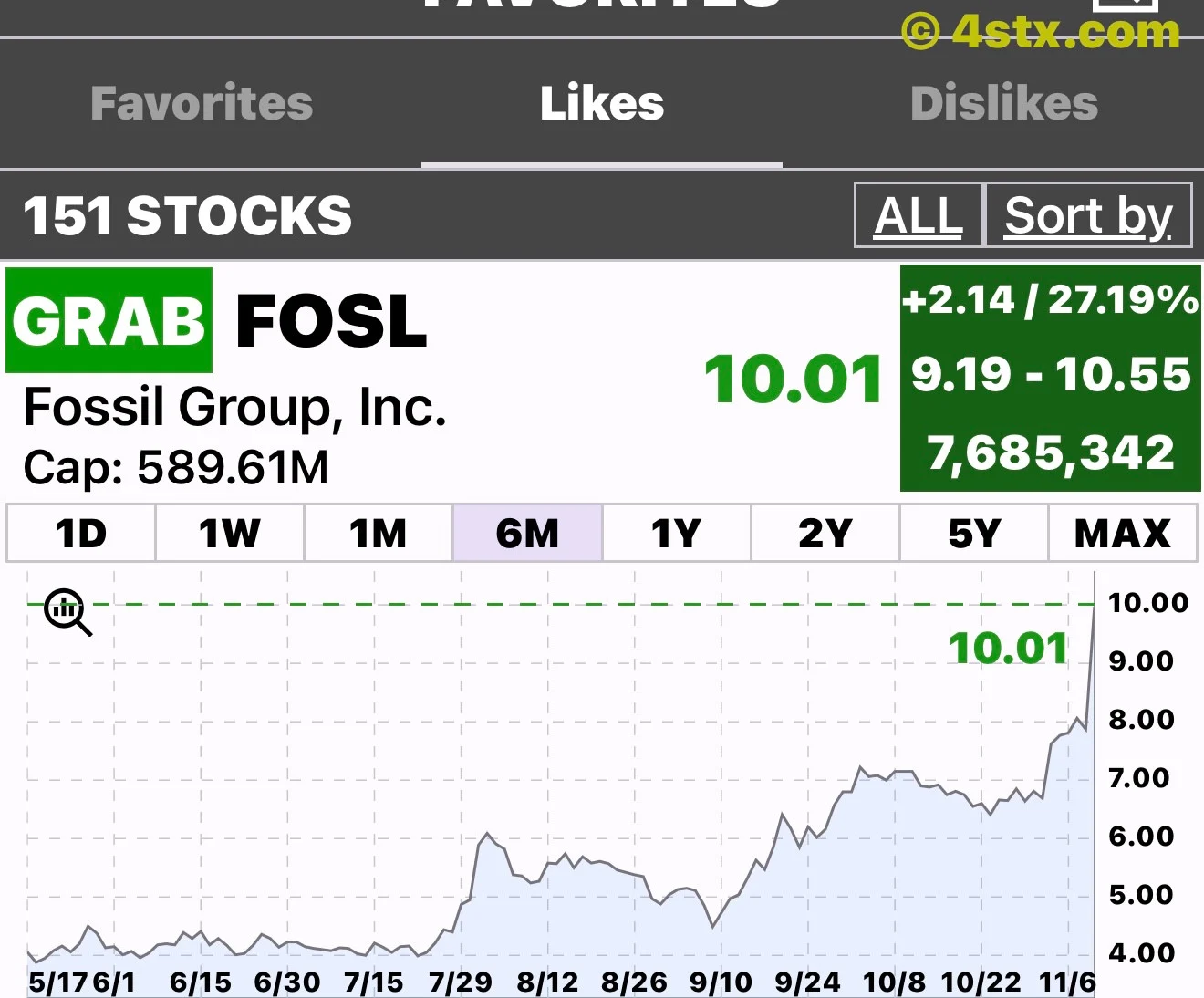
StockRank shows $10.01 and a +27.19% gain. The appeal is not simply selling more watches. It is the possibility of making the business worth more with each sale. That is a much better turnaround argument than revenue alone. Still, one profitable quarter is a milestone, not a guarantee. Investors should watch whether the improvement survives the next selling season and translates into cash after financing costs.
What the six-month chart shows
Fossil’s six-month chart already showed a broad recovery before this latest leap. The line climbs from its spring and early-summer lows, pauses through pullbacks, then makes fresh visible highs. The latest month began less convincingly, with weakness and consolidation, before the November acceleration. That contrast matters: this is a turnaround trade gaining momentum, not proof that the turnaround is finished. The quality of future earnings matters more than the steepness of one day’s chart.
Why the profit line matters more than the sales headline
A watch can look much the same to its buyer while the economics behind it change considerably. The seller can earn more or less on that sale depending on product mix, costs and the terms of the business. That is why a consumer-company recovery does not have to begin with explosive revenue growth. It can begin with keeping more of the money already coming through the door. Fossil's return to profit gives investors a concrete result to examine rather than only a promise of improvement.
The encouraging part is straightforward: a profitable quarter demonstrates that the reported period was not simply another exercise in containing a loss. The harder question is repeatability. An improvement that depends on timing or unusual contributions has a different value from one sustained by stronger everyday economics. Investors should therefore examine the components of future margins rather than assume that the latest quarter can be repeated unchanged. The results announcement is the verified catalyst backdrop; it does not prove why every participant bought the shares.
A raised outlook can also influence valuation because it changes the benchmark against which the coming months will be judged. But a company forecast remains a forecast. It is neither a customer order nor cash already in the bank. After a sharp rally, the market may demand more than it demanded before the announcement. The challenge shifts from showing that recovery is possible to demonstrating that it can continue.
The balance sheet keeps the celebration grounded
The debt figure belongs alongside the profit, not in a footnote investors ignore. Borrowing creates claims on the cash a consumer business generates. A good operating period can help meet those claims, but accounting profit and immediately available cash are not identical. Inventory, customer payments and other working-capital movements can affect how earnings translate into liquidity. This is why a turnaround should be judged through several reporting periods, not one appealing income-statement comparison.
The next questions are practical. Does the company preserve profitability when the selling environment changes? Does it produce cash after funding normal business needs? Does that cash improve financial resilience rather than only supporting the next operating cycle? These are tests for future disclosures, not assertions that Fossil has already passed them. They make the difference between a promising recovery and a durable one.
The six-month chart adds context rather than a guarantee. Investors had already begun repricing the shares before the latest jump, while the most recent month shows how quickly hesitation can become enthusiasm. That acceleration can be exciting, but it should not replace scrutiny of business quality. The good news is a reported return to profit. The unresolved issue is how much of that progress can survive beyond this quarter.
The displayed $10.01 price and 27.19% move are the November 11 app snapshot. They are not independently verified closing figures, and the six-month chart selection does not make that percentage a six-month return.
Alongside earnings, Fossil announced a five-year extension of its Diesel license on November 10, covering watches and jewelry worldwide through 2032. Continuity in a licensed brand relationship can support planning. It does not guarantee customer demand or establish how much of the share-price jump came from this announcement. Diesel licensing extension announcement