
FG Communities Holdings is a small company redirecting its business toward income-producing real estate, particularly manufactured-housing communities, while retaining merchant-banking activities. Its quarter ended September 30, 2026 produced $232,000 in continuing revenue and a $355,000 total net loss. The September balance sheet carried $1.775 million in short-term debt, alongside $35.1 million in cash. This is not yet a large rental-property operator. It is a company trying to turn available capital into a more understandable, recurring business.
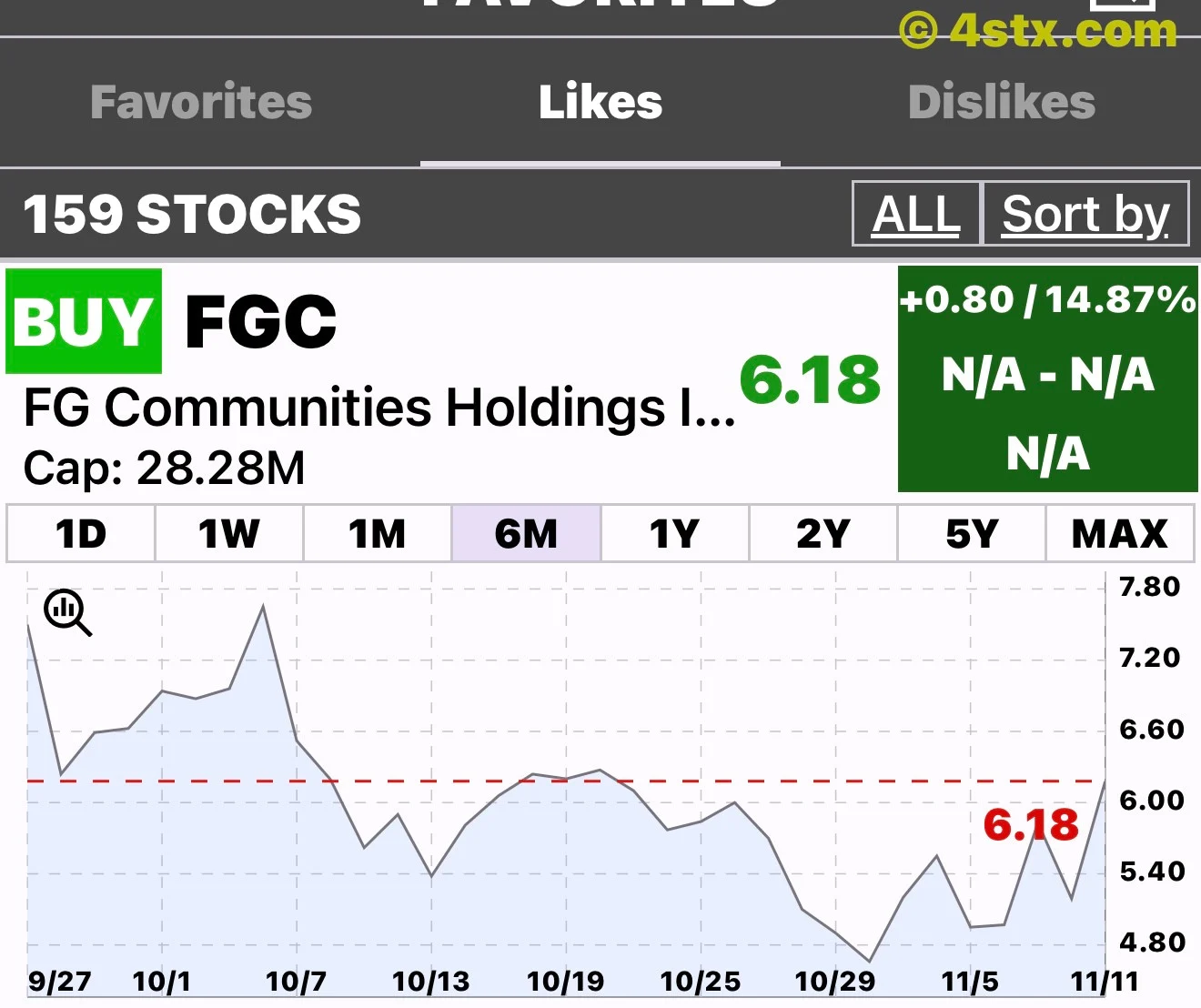
That effort offers the clearest recent context for the stock’s strength. Eric’s November 12 StockRank snapshot showed FGC at $6.18, up +14.87%. On November 11 the company reported its quarterly results and explained progress in its housing strategy. The announcement connects the rally to tangible corporate developments, although it cannot prove the exact reason behind every trade or establish that the screenshot represents a closing price.
Two communities change the conversation
In October, after the reported quarter ended, FG completed its first two directly owned manufactured-housing acquisitions. Garner, North Carolina contributed 49 homesites; Mars Hill added 29. Those 78 sites are modest in scale, but strategically important: management now has actual properties with which to demonstrate its operating approach.
There is an important calendar distinction. The properties were acquired after September, so investors should not read the third-quarter revenue figure as a full-period report card on the new communities. Future results will provide the more relevant evidence about their contribution. A purchase announcement describes deployment of capital; subsequent accounts reveal what that deployment earns.
This is the appealing part of the story. A new direction becomes easier to evaluate when there are identifiable assets, operating expenses and rental receipts rather than only a plan. But it also moves management into an execution test. Finding properties is one task; paying sensible prices and operating them well over time is another.
Cash creates options, not automatic value
FG’s September cash position gives it flexibility, but the date matters. It preceded the October purchases, so that balance should not be treated as the company’s cash today. The same discipline applies when comparing the balance sheet with the valuation shown in an app: the observations may come from different dates and may exclude important obligations or subsequent transactions.
Its SEC quarterly filing reported $1.775 million of debt. That is different from the approximately $4.5 million of total liabilities in the earnings release. Debt and liabilities are not interchangeable: the latter category includes other obligations. Keeping the distinction clear prevents a small company’s financial position from looking either safer or more burdened than the accounts support.
Capital allocation will be central. A dollar used to repurchase shares is unavailable for buying a property unless it is replaced from another source. A dollar kept in reserve preserves flexibility but does not itself establish an attractive return on investment. The eventual test is not whether management can deploy cash quickly; it is whether the resulting assets generate enough value after costs and financing needs.
A smaller loss is a beginning
The continuing-operations loss narrowed to $218,000 from $17.4 million a year earlier. That is a marked improvement, but investors should resist turning a comparison with a difficult prior period into proof of a completed turnaround. Recurring earnings power has to be demonstrated through more than one quarterly comparison, especially when the business itself is changing.
The company also invested $10 million in privately held FG Communities, Inc. That enterprise remains separately operated. The similar names can confuse readers, but the investment should not be mistaken for ownership of every property associated with the private business. The public company’s directly owned communities and its investment in another operator are distinct parts of the story.
The next chapters should be judged through rental income, property costs, acquisition discipline and the funding required to expand. Debt can increase purchasing capacity, while issuing shares can bring dilution. Neither is automatically good or bad; the terms and returns determine the outcome.
The supplied chart has its six-month selector highlighted, but the visible dates run only from September 27 to November 11. It therefore cannot establish a six-month trend. Within the period actually plotted, the broad direction was lower: early prices around $7-$7.50 gave way to a trough near $4.70 around the end of October. The latest rebound toward $6.18 interrupts that decline without recovering the early highs. Over roughly the latest month, weakness was followed by recovery, not uninterrupted strength.
That leaves a useful distinction between price and business. The corporate update makes FGC’s strategy more concrete, which is constructive. Whether the improving recent quote and clearer story become a durable business improvement remains the question investors must keep asking.