
Azenta provides biological-sample management and genomic services. In its September quarter, continuing operations generated $167 million in revenue and about $6 million in net income. Its November 10 release forecast 3%–5% organic revenue growth in fiscal 2027. Its September balance sheet lists no separate bank-loan or bond balance; lease obligations remain. Company results
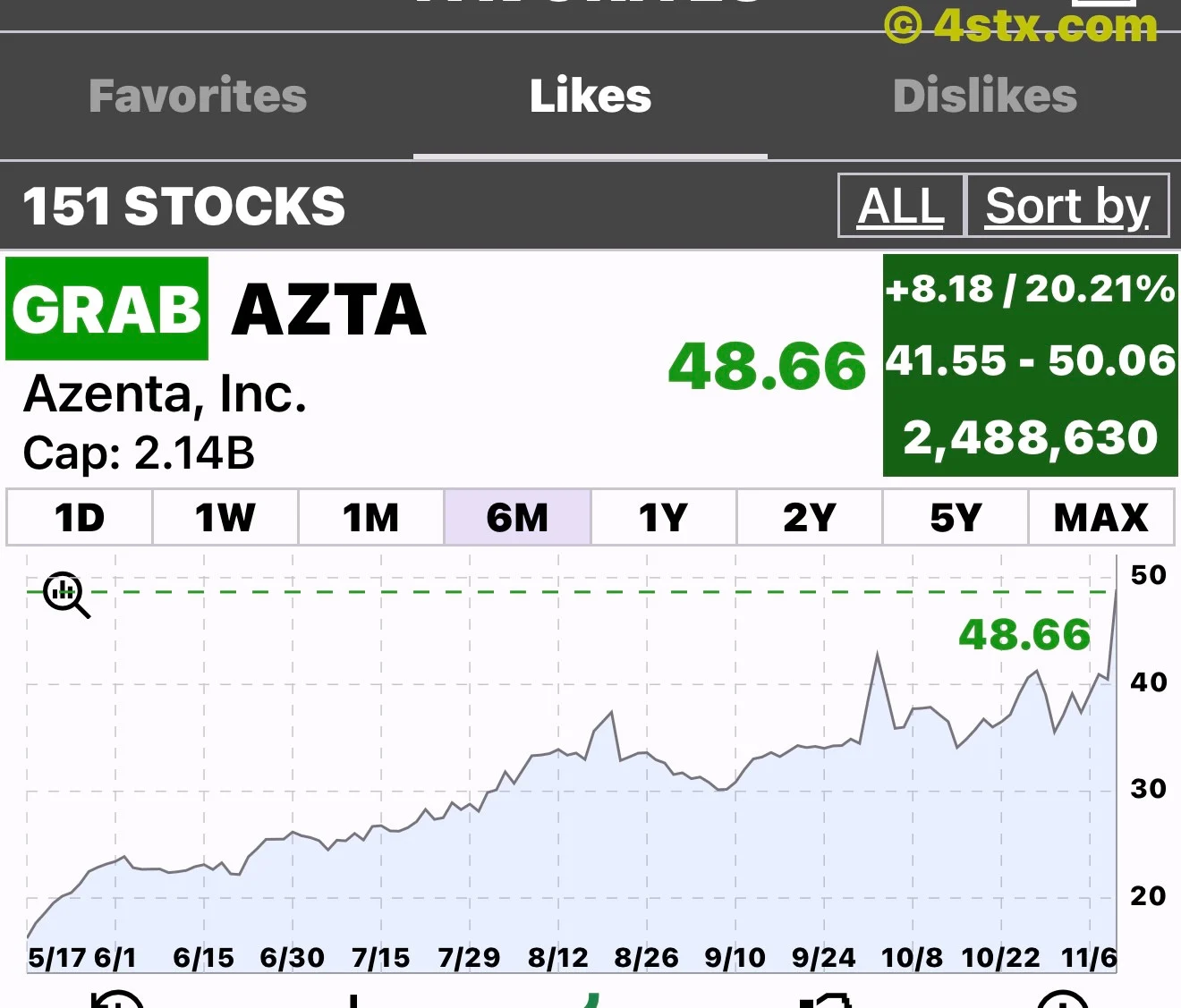
The screenshot shows AZTA at $48.66, up +20.21%. A move that large invites a useful distinction: investors may be buying the prospect of improvement, not celebrating an already completed turnaround. Better execution would be welcome. But a higher share price raises the burden of proof. The story to follow is whether the next quarters validate those expectations, rather than treating this rally itself as validation.
What the six-month chart shows
The chart tells a story of an existing recovery gaining speed. Across six months, the line generally rises despite setbacks in late summer and early October. The latest month remains uneven but points upward, ending with a sharp advance. This is not a sudden escape from a long downtrend: it extends an uptrend already in place. That also means expectations have had time to build. Better results are welcome, but investors now need execution to catch up with the optimism.
The market is paying for the next chapter
A business that stores and manages biological samples and supplies genomic services occupies a different place in the research economy from a company trying to win approval for a single drug. Its investment story is about service demand and execution rather than the outcome of one clinical trial. That distinction helps explain why modest operating improvements and a credible outlook can matter. Customers need useful services, but shareholders also need those services delivered at an attractive economic return.
The latest release gives investors a concrete financial period and a forward target to assess. A forecast is not booked revenue. It is management's expectation, and it can change if demand, customer spending or execution falls short. That is why the favorable interpretation of this rally should remain conditional: the market may be assigning more value to future improvement. We cannot establish the motivation behind every trade simply by matching a price move to a company announcement.
A higher share price can be a welcome signal that confidence is returning. It also removes some room for disappointment. The same quarter can look encouraging when expectations are low and inadequate after expectations rise sharply. Nothing in the screenshot establishes an appropriate valuation multiple, and this analysis does not label the shares cheap merely because their direction is positive.
The financial distinction that matters
Revenue, net income and the balance sheet answer different questions. Revenue indicates the scale of activity; earnings indicate what remains after recorded costs. Obligations tell investors what demands that business may face beyond the next sale. The absence of a separate bank-loan or bond balance in the reviewed presentation should not be translated into an absence of commitments. Lease obligations remain relevant even when they are different from conventional financing debt.
The next useful test is the relationship between growth and profitability. If increasing activity produces a stronger earnings contribution, the recovery case becomes more persuasive. If revenue rises but the cost of servicing it consumes the benefit, the story is weaker. Those are analytical tests, not forecasts of what Azenta will report. Comparing the same continuing operations across periods is essential; mixing discontinued and continuing activities would blur the picture.
The chart supplies a second, distinct observation: optimism did not begin with this particular jump. Its longer upward direction suggests the latest news arrived after an existing revaluation. That makes follow-through in business performance particularly important. An attractive story becomes a durable investment case only when operating evidence continues to support it.
The $48.66 quote and +20.21% gain are November 11 screenshot readings, not independently verified closing figures. The image supports a qualitative trend description, not exact one-month or three-month performance calculations.
There is also a strategic investment story. An October 28 filing records agreements with Elegen to expand gene-synthesis capabilities and the acquisition of SynPlexity. Those steps offer a specific route for developing the business, but acquiring capabilities is not the same as earning an attractive return from them. Gene-synthesis investment filing