
Addex is a small neurological-drug developer with an important investment outside its own laboratory. Its latest reviewed quarterly figures, for June 2026, showed CHF10,000 of income and a CHF1.745 million net loss. That income mainly reflects services received without charge, not commercial drug sales. September 28 financial release
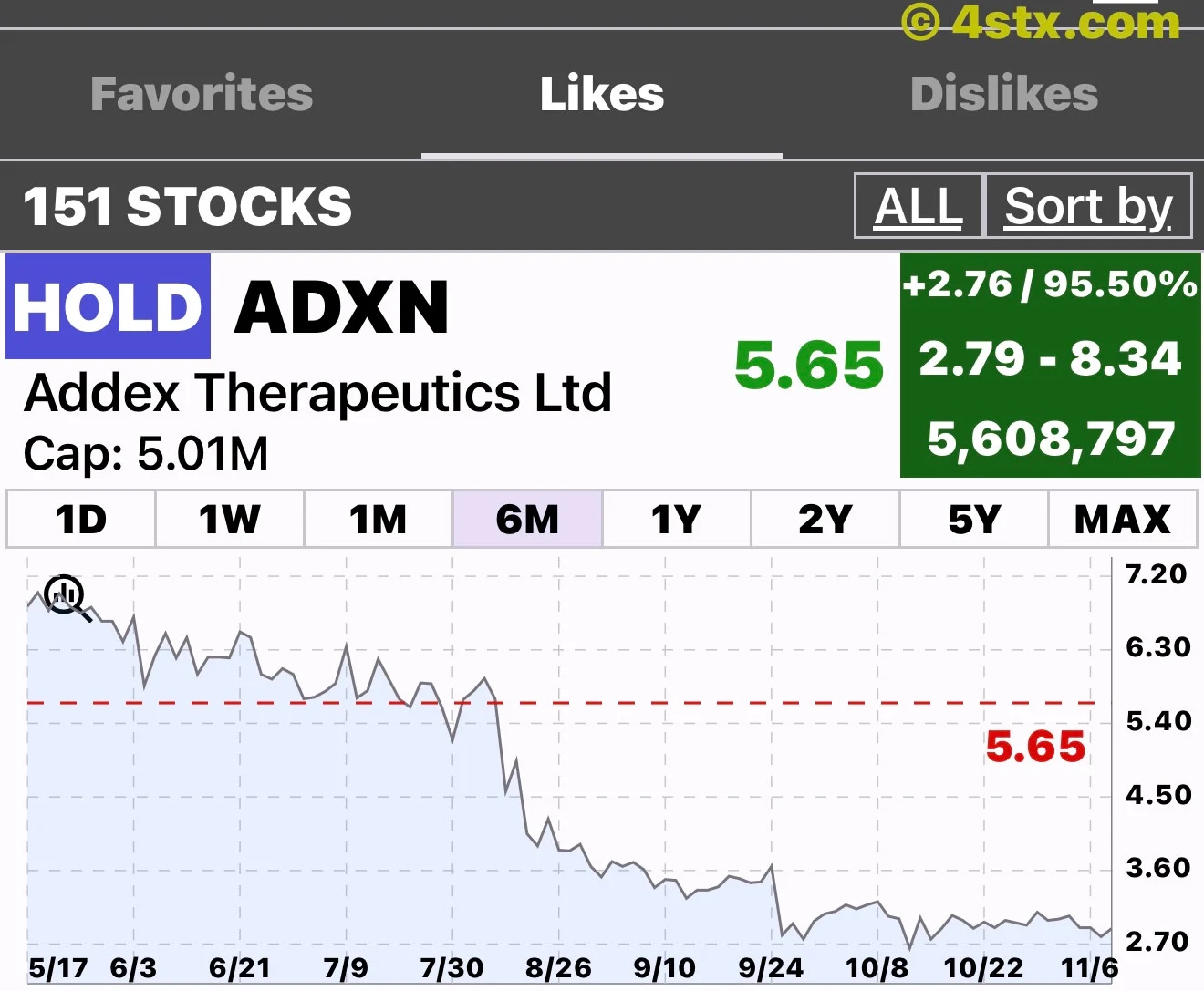
Eric's November 11 snapshot shows ADXN at $5.65, up +95.50%. That evening, Addex announced that spinout Neurosterix raised $105 million. Addex did not invest in the round; its remaining 8.5% interest was valued at $18.6 million. The funding supports planned Phase 2 development of schizophrenia candidate NTX-253. Addex announcement
That is a compelling reason for investors to reassess an overlooked asset. But the $105 million belongs to Neurosterix, not Addex's checking account. A private-stake valuation is also not a cash realization or a guarantee of successful trials. The story is potential investment value becoming more visible, not a sudden $105 million windfall for ADXN shareholders.
What the six-month chart shows
The supplied six-month line had generally fallen, then moved sideways near its lows during the latest month. There is a crucial timing mismatch: the plotted line finishes near $2.80, while the screenshot’s quote reads $5.65. The quote surge has not appeared in that plotted history. We therefore cannot describe the last plotted segment as a completed breakout. The after-hours announcement offers a concrete catalyst for a reassessment, but the screenshot combines a newer quote with an older-looking series. A verified current debt figure was not established in this research.
An investment is not the same as cash
This is a useful example of why the biggest percentage move on a screen can require the most careful explanation. There are two businesses in the story, and their finances cannot be combined casually. The financing can help the underlying research program move forward. Addex shareholders gain exposure through their ownership interest, not direct ownership of the newly raised cash. That distinction should sit at the center of any valuation discussion.
The announced stake value is a reference point, not an immediately redeemable amount. A private investment is not necessarily saleable at its stated valuation whenever the holder chooses. Future clinical results, financing terms and commercial prospects can change what that interest is ultimately worth. Comparing it mechanically with a public company's market capitalization would leave out the rest of the parent's assets, obligations and continuing spending. With current debt not verified here, claiming a precise discount to net asset value would be especially misleading.
What would make the rally more durable?
The constructive interpretation is that external financing gives investors a clearer reason to pay attention to an asset that may previously have received little recognition. The less comfortable part is that a dramatic quote change can arrive before the evidence needed to judge lasting value. Funding research and demonstrating that a therapy works are separate achievements. Neither should be described as a substitute for the other.
For that reason, I would frame this as a change in what investors are noticing, not proof that all the financial risks have disappeared. The next useful checkpoints are clinical progress at the investment and updated financial disclosures at the parent. Those can help establish whether the new attention is supported by operating progress.
The screenshot itself reinforces the need for care: a newer quote alongside an older plotted line can create the impression of a chart confirmation that is not actually visible. The displayed gain is a snapshot, not a verified closing return or a six-month performance calculation. Before drawing exact monthly comparisons, the series and its timestamps need to agree.